Burberry Gray Check Slides: What to Verify First
-
Find your place
The difficulty in buying gray check slides isn't just choosing a size. The listing provides TPU upper, rubber outsole, molded footbed, and sizes 35–45, but public buyer feedback conflicts on sizing: some recommend sizing up, some say true to size, and others think newer versions run large and advise sizing down at least one. So the safest approach isn't to follow any single experience, but to first verify specific measurements, footbed shape, and QC photos before deciding to order. 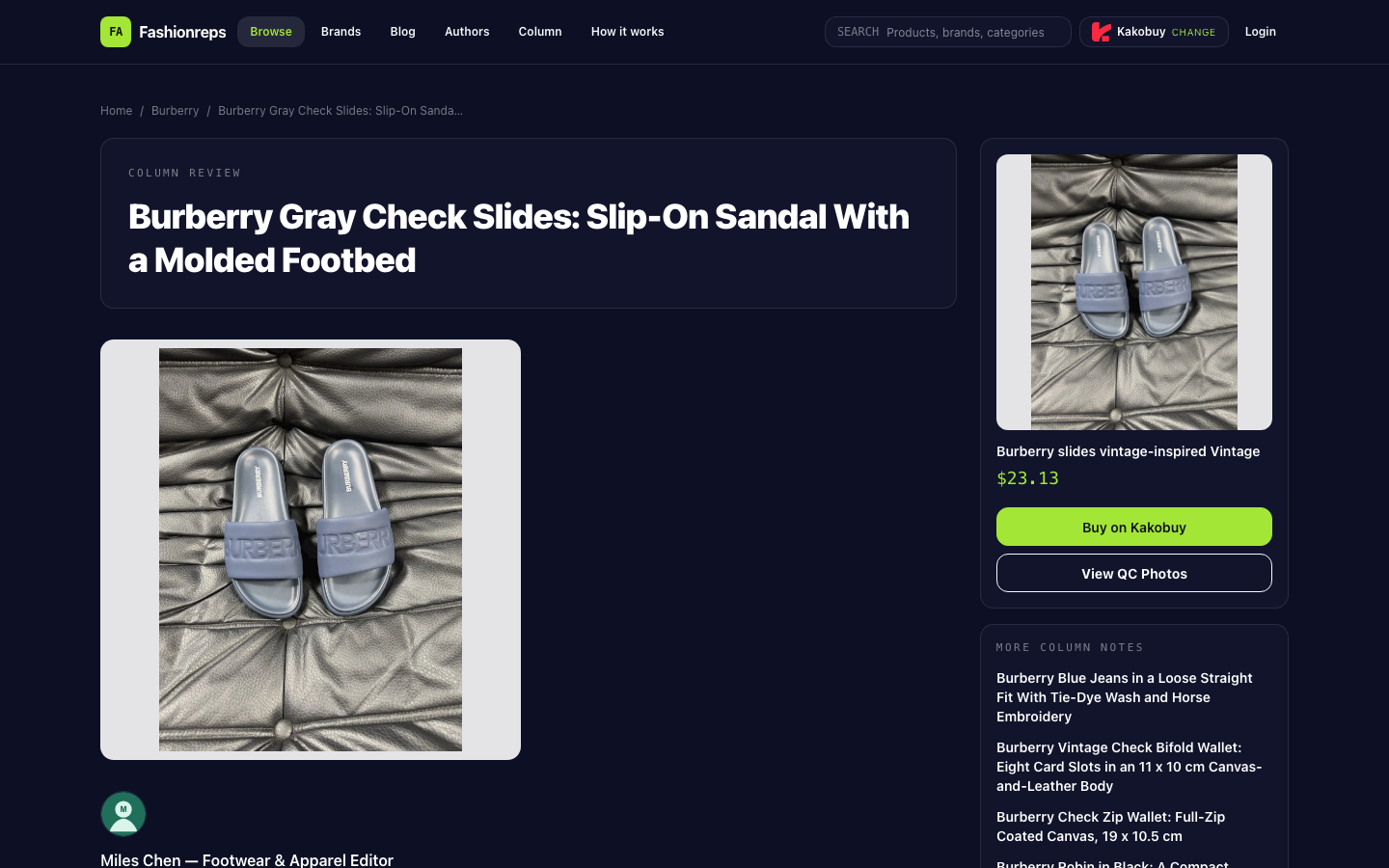
Editor score 4.2 / 5
The difficulty in buying gray check slides isn't just choosing a size. The listing provides TPU upper, rubber outsole, molded footbed, and sizes 35–45, but public buyer feedback conflicts on sizing: some recommend sizing up, some say true to size, and others think newer versions run large and advise sizing down at least one. So the safest approach isn't to follow any single experience, but to first verify specific measurements, footbed shape, and QC photos before deciding to order.

First, Confirm What the Listing Explicitly States
The listing describes these as gray Burberry check slip-on slides with an open-toe design, molded footbed, and embossed branding on the side. It lists materials as 100% TPU upper and 100% rubber outsole, with sizes 35 to 45, and size 45 noted as requiring customization.
This information only reflects the product listing's claims and cannot substitute for verifying the specific batch. Especially details like footbed length, forefoot width, and the connection between the strap and sole aren't sufficiently detailed in the listing summary. Before purchasing, ask the shopping agent or seller for actual measurements and QC photos for the specific size.
The listing shows a reference price of $23.13 and another final product price hint of $26.35. It also states that service fees and international shipping need to be confirmed on the shopping agent's website. Therefore, the listed price cannot be treated as the complete total cost, nor can inventory or final payment be inferred from it.
Why Size Opinions Cannot Be Merged into One Answer
Public feedback falls into at least three categories:
- Some buyers recommend sizing up from your usual size.
- Some buyers feel these slides are true to size.
- Other buyers think newer versions run large and suggest sizing down at least one.
These three conflicting opinions show that neither "size up" nor "true to size" covers all cases. Possible reasons for the discrepancies include foot length-to-width ratio, personal preference for open-toe length, different batches or versions with different sole materials, and whether buyers based their judgment on bare foot length or their usual sneaker size. However, the current listing doesn't provide enough evidence to prove which specific factor causes the differences, so these possibilities cannot be written as definite conclusions.
A more reliable order of judgment is: first measure your foot length, then compare it with the seller-provided insole length or footbed length; if your foot width, instep height, or toe position is unusual, also ask about forefoot width and footbed shape. Only when the size data matches your own measurements can buyer feedback be useful.
Four-Step Verification Before Ordering
Step 1: Establish Your Baseline with Bare Foot Length
Stand with your heel against a wall, mark the position of your longest toe on paper, and measure both feet separately. Use the longer foot as the baseline and record foot width. Don't just state "I usually wear a certain size in a certain brand," because size labels across different brands and shoe types cannot be directly converted.
Slides need some space at the front, but the listing doesn't provide a recommended allowance or a complete size chart. When asking, request confirmation of the insole length or effective footbed length for the target size, rather than just "true to size" or "size up."
Step 2: Request Actual Measurements for the Specific Size
Questions can focus on the following:
- Insole length or footbed length for the target size.
- Width at the widest part of the footbed.
- Whether the upper opening will restrict those with high insteps.
- Whether there are obvious differences in length or appearance between left and right shoes.
- Whether size 45 truly requires customization, and the customization period and exchange/return restrictions.
If you only get a generic size chart and not actual measurements for the specific size, treat the verification as incomplete rather than assuming the size chart is accurate.
Step 3: Check Footbed, Strap Connection, and Outsole Details
The listing highlights molded footbed and rubber outsole. QC photos should focus on whether the footbed has obvious collapse, whether edges are deformed, whether left and right textures are roughly consistent, and whether the strap-to-body connection shows separation, glue overflow, or obvious asymmetry.
Public feedback also mentions that some buyers think newer versions use a harder rubber sole formula, which may be less comfortable than older versions. The listing evidence for this claim has limited confidence, and there's no unified standard for identifying versions, so it should be treated only as a comfort risk warning, not a conclusion that all batches are harder. If you need soft, cushioned slides, ask directly about sole hardness or version differences before purchasing, and accept that the seller may not be able to answer accurately.
Step 4: Confirm Return/Exchange and Customization Boundaries
When size feedback is contradictory, the return/exchange policy is part of the purchase decision. Confirm before ordering:
- Whether size mismatches can be returned or exchanged.
- Whether returns require unworn, unstained, or original packaging.
- Whether customized sizes are excluded from return/exchange.
- What photo or measurement evidence is needed for after-sales if the size doesn't match the listing.
- Who bears the cost of international returns.
If these conditions cannot be confirmed and your foot shape isn't suitable for trial and error, it's often safer to pause the purchase than to rely on a single buyer's experience.
How to Match QC Photos to Size Judgment
QC photos cannot prove a perfect fit, but they can help rule out obvious issues. When viewing, don't just look at the check pattern and side logo; correlate the photos with the target size, left/right shoes, and seller-provided measurements.
Recommended inspection order:
- First confirm that the QC photos are for the style and size you intend to buy, not other images from the same series.
- Check if the footbed length matches the seller's stated data, rather than estimating from photo proportions.
- Inspect the strap connection for cracks, obvious glue marks, or left-right asymmetry.
- Observe whether the rubber outsole edges are severely deformed and whether the footbed surface shows obvious dents.
- If key areas are unclear in the photos, request close-ups; if not possible, mark that item as unverified.
The listing also mentions that worn slides may tear at the strap and may require cleaning, glue reinforcement, filling, and repainting. This is public durability feedback with low evidence confidence; it cannot predict a specific pair's lifespan, but it indicates that the strap connection deserves attention during QC.
When to Continue Asking and When to Pause
Suitable situations to continue asking: You have measured your foot length and width, the seller can provide actual measurements for the target size, QC photos correspond to the specific size, and return/exchange boundaries are clear. This still doesn't guarantee fit, but at least the basic evidence verification is complete.
Situations where you might consider ordering but with risk awareness: Size data basically matches, footbed and connection show no obvious QC issues, and the shopping agent allows handling size mismatches under reasonable conditions. In this case, don't treat the listing reference price as the final cost; wait for service fees, international shipping, and actual inventory confirmation.
Situations where you should pause: The seller only gives vague answers like "true to size" or "size up"; actual measurements for the target size are unavailable; QC photos cannot be matched to the specific size; after-sales conditions for customized sizes are unclear; or you clearly need soft soles but cannot confirm current batch hardness and version.
Conclusion
These gray check slides currently have no unified sizing answer that covers all buyers. The listing clearly provides TPU upper, rubber outsole, molded footbed, and sizes 35–45, but buyer feedback is significantly divided between sizing up, true to size, and sizing down. Before purchasing, start with your own foot length and width, request actual footbed measurements for the target size, check the footbed and strap connection in corresponding QC photos, and confirm return/exchange and customization restrictions.
If the seller cannot provide this information, treat the size judgment as incomplete rather than substituting a single experience for evidence. Only then can you make a more controlled decision balancing price, comfort, and after-sales risk.
Community feedback
0 approved
- Readers
- No approved comments yet.
Keep reading on this site
Black Drawstring Athletic Shorts: Color & Styling Tips / Supreme, Polo, Carhartt Winter Flat-Lay: Color & Styling / Winter Streetwear Flat Lay: Jackets, Sweats & Details