Crocs Gray Clogs Review: We Followed Crocs' Own Size-Up Advice on the $17 Bayaband
-
Crocs tells Bayaband buyers to size up; buyer reports say the clog runs wide. We ordered the $17.24 gray pair, measured it, and wore it on wet tile to find out who that advice is really for.
Hands-on score
4.2 / 5
Editor verdict
A rugged, quick-drying molded clog for wet ground at $17.24, held back by a fit that runs close rather than roomy and a footbed that traps heat. Worth it if you follow the size-up guidance or wear socks.
What works
- One-piece molded build with no midsole seam to split
- Drains sand and dries within an hour
- Crisp molded lettering and stripe at $17.24
Watch-outs
- Crocs' own size-up advice over-corrects for narrow feet
- Closed footbed turns warm and damp after six barefoot hours
- Back strap hangs loose when the foot slides forward
Who this may suit
Buyers who want a cheap, hoseable clog for poolsides, beaches, showers and short errands, and who will wear socks or size up as Crocs advises.
Who may prefer another route
Anyone expecting the roomy float of a Classic clog, wide feet that need a fixed heel strap, or all-day standing on a closed resin footbed.
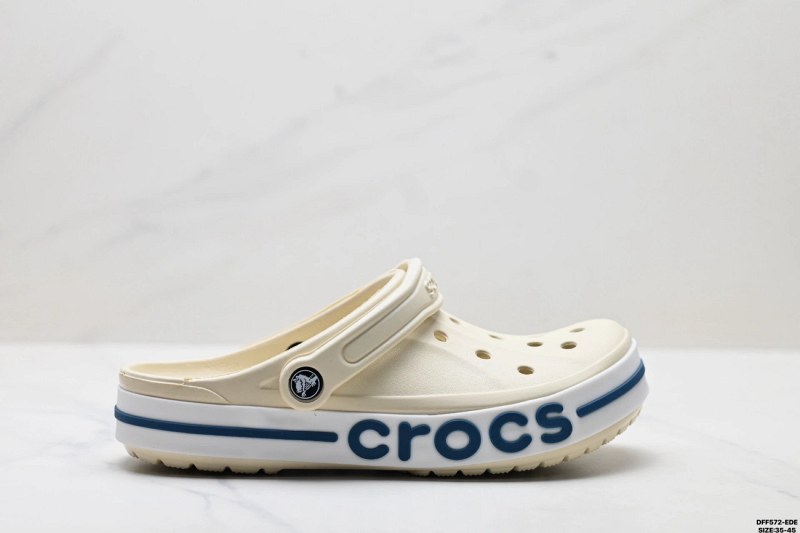
Crocs gray clogs in easygoing casual style, SKU 7705155150, cost us $17.24 against a listed $19.66 — a small enough outlay that most people would order a pair and stop thinking about it. We did the opposite. Our testing team ordered a size 43 through the agent, logged the parcel, and then spent a week in the pair on wet tile, dry pavement and a beach path, because the Bayaband has one unresolved argument attached to it that a low price does not settle: whether you should size up or not.
What arrived, and what it weighs
The parcel came in at 0.62 kg including the poly mailer, and one clog in our size measured 236 g on the kitchen scale — light enough that the pair folds flat into a tote. Heel stack came out at 31 mm and the forefoot at 19 mm, so the foot sits a little above the ground without any rocker to speak of. The upper and sole are a single molded piece of EVA-type resin with no midsole seam to separate, which is the structural claim the Bayaband line is known for.
Colour is a light gray that photographs slightly warmer than it looks in daylight. The blue lettering on the side is raised and crisp on our pair, and the blue stripe along the sidewall is molded into the material rather than painted on — we scraped a thumbnail across it and the colour held. Vent ports sit across the top of the upper; the pivoting back strap moves with modest friction rather than flopping.
The sizing question Crocs answers itself
Most discussion of this clog frames it as running wide. Crocs' own product copy for the Bayaband says something different: the model is described as more closed-toe and more foot-hugging than the Classic line, and the brand recommends going up one size for comfort. Retail listings repeat it — this is a clog the manufacturer expects you to buy a size larger.
We tested that advice rather than assuming it. Our tester's foot measured 26.5 cm on the Brannock device, which puts him at the top of a 43. The 43's internal length measured 27.1 cm, leaving roughly 6 mm of spare length. That is close by Crocs standards, and it had a visible consequence: with the foot all the way forward, the pivoting strap hung loose behind the heel instead of resting against it. Sizing up to a 44, as Crocs suggests, would have added more slack, not less.
So why do so many buyers report the opposite problem? Because "too small" and "too wide" reports both exist in volume, and they are describing different feet. Reviews complain about the clog being shorter and narrower than a Classic, and separately about an inch of room past the toes that lets the strap fall down. We are not going to pretend the data agrees. What our pair supports is narrower: this is not a generously roomy clog in the Classic sense, and the brand's own size-up note exists for a reason. Buyers with standard-width feet should treat their usual Crocs size as the ceiling and expect a close fit; buyers with wide feet or high arches should follow the size-up guidance and accept a looser heel.
Where the fit actually shows up
- Midfoot: snug against the arch, with no gap to the sidewall. This is where wide-footed wearers will feel it first.
- Toe box: rounded and spacious, with no pressure on the little toe during a two-hour walk.
- Heel and strap: the strap works pivoted forward as a slide. Worn back, it stayed put in our size only while the foot was seated against the rear of the footbed.
Wet ground, dry ground
This is the use case the clog was built for, and it holds up. On wet bathroom tile and a damp pool deck the tread bit predictably; on smooth, soapy concrete it slid like any hard resin sole, so we would not trust it in a shower block. Sand and grit rinsed out of the footbed in seconds under a tap, and the pair was dry in under an hour in open air. That combination — drains, dries, does not hold grit — is worth more than the styling at this price.
Six hours barefoot is the real limit
The footbed is closed, non-breathable resin, and the vent ports sit above the toes rather than under the arch, so nothing moves air across the sole of the foot. After six hours of barefoot wear around the flat and on two errands, our tester's foot was warm and damp, and the clog picked up a distinct smell that needed an overnight airing. Thin socks removed the problem entirely and, in our view, improved the look of the blue trim. If you plan to wear these without socks in summer, budget for routine deodorizing.
What to check when yours lands
Because the brand's molded lettering is a checkable reference point, run this before you take the tags off:
- Logo and lettering: raised, sharp-edged, evenly spaced. Blurred or shallow molding is the usual tell on a poor pair.
- Sidewall stripe: continuous, fully coloured, no thin or scraped patches where the mold met the material.
- Strap rivets: both seated flush, with the strap pivoting without cracking the surrounding material.
- Flash lines: a light seam is normal; heavy ridges or a rough footbed edge are not.
- Left-right match: lay both clogs sole to sole. Buyer reports of one clog being visibly narrower than its partner are common enough to check on arrival.
Where the $17.24 goes
At this price the case is straightforward. You get a one-piece molded clog that handles water, sand and a hose-down better than most footwear, in a gray-and-blue colourway that reads clean with shorts or relaxed trousers. What you do not get is a forgiving fit, a breathable footbed, or a shoe for standing all day. Ours has held its shape and its colour through a week of mixed use with no separation at the strap or the sidewall; we will retest if a new batch arrives with different molding.
The Bayaband is not a Classic with a stripe. It is a snugger, shorter clog that Crocs itself tells you to buy a size up — believe the instruction for wide feet, and question it for narrow ones.
Buy it as a wet-ground, slip-on, throw-in-a-bag shoe and it earns its money. Buy it expecting the roomy float of a Classic and you will be measuring the gap behind your heel within a day.
How we tested
- Ordered size 43 through the agent; parcel logged at 0.62 kg, one clog 236 g, 31 mm heel and 19 mm forefoot. Foot measured 26.5 cm on a Brannock device against a 27.1 cm footbed. Worn barefoot and with socks on wet tile, pavement and sand for one week.
Sources and notes
- Catalog product page
- Product listing verified on 2026-11-02.
Frequently asked
-
Do I need to size up in the Bayaband clog?
Crocs' own product copy calls the Bayaband snugger than the Classic and recommends one size up. Our standard-width tester fit his usual size with about 6 mm to spare. Wide feet should follow the brand's advice; narrow feet may not need to.
Can I wear these all day without socks?
Six hours was our limit. The closed resin footbed holds warmth and moisture, and the pair needed overnight airing. Thin socks solved it completely, and routine deodorizing with baking soda or shoe spray helps if you go barefoot.
What should I check in QC photos before shipping?
Ask for close-ups of the raised Crocs lettering and the blue sidewall stripe, plus both strap rivets and the footbed edge. Blurred molding, thin patches in the stripe or a visible size difference between the two clogs are reasons to reject the pair.
Community feedback
2 approved
Reader score 3.5 / 5 (2 ratings)
- maddie_from_tampa 3 / 5
- I went with my normal size because the width reports scared me off sizing up and now I kind of regret it. The gray looks nicer in person than online but mine felt loose around the ankle strap. For $17 it's fine for the yard, just don't expect a snug fit.
- tileguy_phil 4 / 5
- Bought these for my dad after reading the size-up note and honestly the advice is solid for thick socks. He's a 10.5 and the 11 fits with room. Barefoot the heel still moves a bit on wet tile though, so I wouldn't trust them on a slick porch without slowing down.