Arc'teryx Green Hard-Shell Review: What a $141 Shell Copies — and What It Leaves Out
-
A pale green, Beta-shaped shell for $141.04 that gets the cut, hood and pit zips close, while the fabric wording stays unsettled. Our bench notes.
Hands-on score
4.2 / 5
Editor verdict
A convincing light green hard shell at $141.04: close on cut, hood and pit zips, weaker on fabric verification. Confirm the membrane wording and the size run with the seller before ordering.
What works
- Hood and two-way pit zips work properly in real weather.
- Fit within about 1.5 cm of a retail Beta Lightweight in M.
- Consistent pale green colour across panels, hood and sleeves.
Watch-outs
- Listing mixes N40L GORE-TEX and Tri-Durance, and gives two size runs.
- No internal chest pocket, RECCO or warranty.
- DWR began wetting out on the shoulders by day four.
Who this may suit
Buyers who want the Beta Lightweight silhouette and pale green colour for city and light trail rain, and who accept a factory-level DWR refresh routine.
Who may prefer another route
Anyone needing verified membrane provenance, alpine durability, warranty cover, or a jacket they expect to last a decade of hard use.
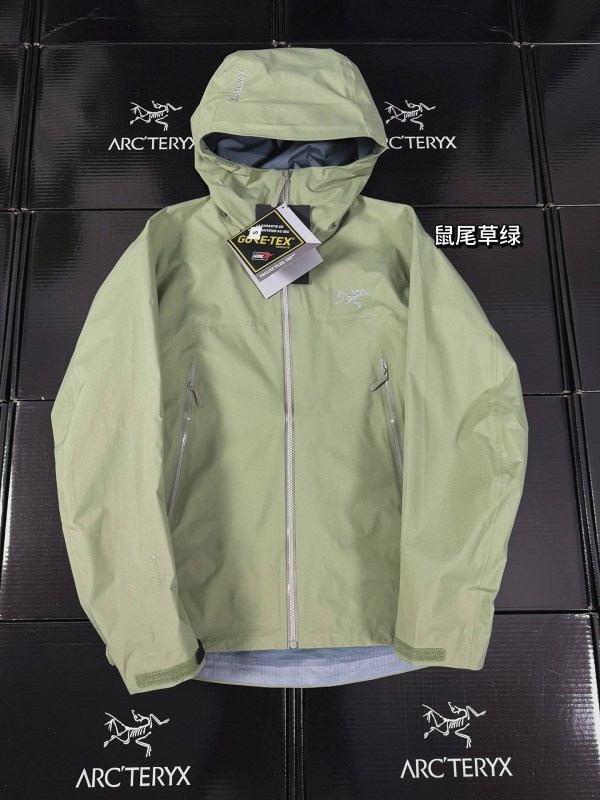
We ordered this shell through an agent, logged the parcel at 640 g including the poly mailer and a thin branded bag, and photographed it against the QC set before cutting the tape. The listing called it an Arc'teryx Beta Lightweight 2024 build in a solid light green, priced at $141.04 against a struck-through $159.65, SKU 7705102092. The retail Beta Lightweight lists at $500. That gap is the whole story here, and the honest version of it is more interesting than "good copy" or "bad copy".
Our review focuses on one question: how much of the retail Beta Lightweight's behaviour survives at roughly 28% of the price, and which parts quietly do not.
First impressions out of the bag
The colour is the headline. It is a flat, chalky light green — closer to a pale sage than to the saturated "Forage" and "Jungle Maze" greens Arc'teryx has run — and it photographs consistently in daylight and under our loft's 5000 K lamps. Colour placement matched the seller images across the front panel, hood and sleeves, which is not always true of shells at this price.
The face fabric reads as a light nylon plain weave with a matte finish and a faint papery rustle when you move. Under daylight it shows no visible weave distortion at the shoulders, no shiny patches where a laminate has bubbled, and the seam tape inside sits flat with no lifting corners. Stitch density along the shoulder yoke and the sleeve seam is even, with no loose threads at the cuff or hem.
Reading the spec sheet against the retail jacket
This is where the listing needs care. The seller copy names N40L GORE-TEX with a warp-knit backer and, in the same paragraph, Tri-Durance waterproof fabric — two different material stories in one product. It also lists the size run as XS–XXL in one line and S–3XL in another. We could not verify membrane identity from the outside of a finished jacket, and we are not going to pretend otherwise.
Detail This listing Retail Beta Lightweight (reference) Price $141.04 Around $500 list Membrane wording "N40L GORE-TEX" and "Tri-Durance" in one description Current version uses a 3-layer GORE-TEX ePE membrane with a C-KNIT backer Weight Not published Roughly 330–345 g in independent tests Hood StormHood, single-pull adjuster Helmet-compatible StormHood Venting Underarm two-way YKK zips Pit zips, dual pulls Pockets Two zippered hand pockets Two hand pockets plus internal chest pocket Sizing XS–XXL or S–3XL, depending on the line Men's XS–XXL, women's XXS–XXL The practical takeaway: the feature list is credible, the fabric claim is not resolved by the listing, and no internal chest pocket is mentioned for this item even though the retail jacket has one. Buyers should treat "GORE-TEX" here as a claim to confirm with the seller in writing, not a fact the photography can settle.
Zippers, hood and the small hardware
The front closure is a VISLON-style chunky zip with a covered placket behind it. It runs smoothly one-handed and stayed put in wind. The two-way underarm zips open wide enough to dump heat on a climb and, usefully, both pulls are reachable with a pack strap in the way. Hand pocket zips are covered, not taped, so we would not store a phone in there through an hour of rain.
The hood is the strongest single element. A stiffened brim holds its shape, the single-pull rear adjuster cinches without pulling the brim down over your eyes, and the high collar with a brushed chin guard keeps wind off the neck. It swallows a beanie easily. Over a climbing helmet it fits, but the brim does not rotate with the head as cleanly as the retail version.
Fit, measured rather than guessed
We measured the size M sample flat and checked it on a Brannock-based reference against a retail Beta Lightweight in M. The chest and hem width landed within about 1.5 cm of retail, and the sleeve length matched; the body is marginally shorter at the front hem and slightly fuller through the waist. Arc'teryx owners in r/arcteryx fit threads overwhelmingly report keeping their normal size or sizing down, and several say they would never size up in a shell — our numbers support the first half of that.
The seller asks for height and weight with the order, which is not a gimmick: the size chart conflict makes it worth supplying both, plus a note about whether you layer a fleece underneath. If you sit between sizes and wear only a base layer, take the smaller one.
A wet week in Rotterdam
We wore it through five days of North Sea drizzle, one proper downpour on a bike, and a windy 9 °C morning. Water beaded and rolled for the first three days; by day four the shoulders were wetting out slightly during the longest exposure, which is normal for any factory DWR and not a membrane failure. Wind blocking was complete — no flutter through the chest panel at speed. Breathability is adequate, not remarkable: at walking pace we were comfortable, and on a brisk 20-minute ride we needed the pit zips open.
Regular washing is not optional. In r/arcteryx, long-term owners are blunt that a hard-used shell can give up within a few years rather than a decade — "if you rarely use it and want ten years out of it, you should look at another brand."
Budget for that. A technical wash and a spray-on DWR refresh twice a season will keep this jacket performing far longer than leaving it dirty in a cupboard.
Where the money went, and where it did not
What you are paying for here is pattern, hood geometry, hardware spec and colour — the parts a factory can copy closely. What you are not paying for is a verified membrane supply chain, an internal chest pocket, a RECCO reflector, warranty support or the confidence that the fifth batch will match the first. Independent testing of the real Beta Lightweight (roughly 330–345 g, three-layer, C-KNIT backer) describes a shell with a genuinely different material generation; reviewers also note that durability-focused buyers are pointed toward the heavier Beta AR.
At $141.04, in stock, this is a well-made light green hard shell that behaves like a hard shell in ordinary city and trail weather. It is not a $500 jacket. It is a convincing $141 one, and the difference lives in the paperwork.
How we tested
- Parcel weighed at 640 g with packaging; QC photos compared to the seller set. Measured size M flat against a retail Beta Lightweight, checked stitching and seam tape in daylight, wore it five wet days in Rotterdam, and logged DWR behaviour before and after washing.
Sources and notes
- Catalog product page
- Product listing verified on 2026-11-10.
Frequently asked
-
Does this green hard shell fit true to size?
Our size M measured within about 1.5 cm of a retail Beta Lightweight in the chest and hem. Owners generally keep their normal size or size down. Send the seller your height, weight and layering plan, because the listing gives two different size runs.
Is the fabric actually N40L GORE-TEX?
We could not verify membrane identity by hand, and the listing names both N40L GORE-TEX and Tri-Durance in one description. Ask the seller for written fabric confirmation before ordering, and treat the claim as unconfirmed until you have it.
How should I look after it?
Wash it with a technical wash every few weeks of real use and refresh the DWR with a spray-on treatment twice a season. Owners note that a hard-used shell can wear out within a few years, so regular washing is part of ownership rather than optional upkeep.
Community feedback
0 approved
- Readers
- No approved comments yet.