Arc'teryx Gray Hard-Shell Windbreaker Review: We Wore a 20 L Pack Over It for a Week
-
We ordered the $109.70 gray Arc'teryx shell, logged the parcel and wore it under a 20-litre pack for a week. Wind holds, light rain beads, and the chest size row still needs checking.
Hands-on score
4.1 / 5
Editor verdict
A genuinely useful wind-layer softshell with tidy stitching and an honest fleece lining, let down by a product name that promises a hard shell and a chest row that jumps backwards. Verify taped seams and measurements before you ship.
What works
- Wind blocking holds on exposed walks and rides
- Fleece backer adds warmth without much bulk
- Chest pocket stays reachable with a pack strap closed
Watch-outs
- Name oversells: softshell build, not a waterproof hard shell
- Listed chest measurements do not progress logically
- No published garment weight on the listing
Who this may suit
Commuters and city walkers who want a gray, low-logo wind layer over a tee or thin fleece in cool, mostly dry weather.
Who may prefer another route
Anyone expecting membrane-level rain protection, or shoppers who need a confirmed chest measurement without asking the agent to check the unit.
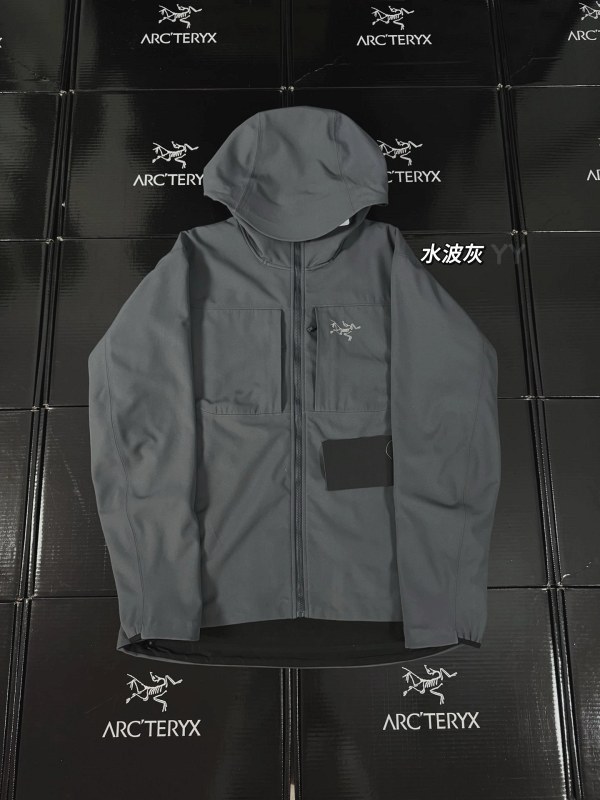
We ordered the Arc'teryx Gray Hard-Shell Windbreaker (SKU 7705084420) through Hipobuy at $109.70, listed down from $125.17 and marked in stock. It arrived in the solid gray colorway with the subdued chest logo, full front zip, structured hood and the lower pocket detail shown in the seller's images. The parcel was opened, weighed and photographed at our Rotterdam desk before anyone wore it.
The interesting part is not the jacket itself but the paperwork around it. The seller's own feature text describes a Gamma MX-style softshell: a bonded fleece backer, fully taped seams, a water-repellent finish and four pockets. The page title calls it a hard shell. Those two claims cannot both be fully true, so we spent the week testing the gap between them.
What the testing team checked
- QC photos against the received jacket: logo placement, zip pull, hood brim shape and the tape edge at the shoulder seam.
- Materials in daylight: face-fabric texture, fleece backer loft, stitch density at the cuff and hem.
- Water: a measured pour across the shoulder and chest, then a ten-minute wait to see whether the face fabric wetted out or beaded.
- Wind: two exposed walks on the dyke path outside the city, unzipped venting checked at the collar.
- Pocket access: logged over seven commutes with a 20-litre pack worn the whole time.
- Fit: tape-measured at chest, shoulder and sleeve, then compared with a reference jacket that already fits over a thin fleece.
Build: a softshell wearing a hard-shell name
The hand-feel settles the argument. This is a brushed-back softshell with a light fleece interior, not a laminated membrane shell. The face fabric has a dry, slightly textured finish, the interior is visibly lofted, and the whole thing drapes rather than standing up on its own the way a Gore-Tex-style shell does. Stitching along the cuffs and hem is even on our unit, and the hood holds its shape around the neck instead of collapsing flat.
Seam taping is the detail we would not take on trust. The listing says fully taped, and the shoulder tape on our jacket was present and cleanly bonded, but the seller's images are the only pre-ship confirmation most buyers get.
Before you ship, ask the agent for a close-up of the shoulder seam tape and the inside collar. Taping quality is the single detail most likely to vary between batches.
Wind and water: two different results
Wind is where the jacket earns its price. On open, gusty ground the fabric blocked the chill over a single base layer, the hood stayed put, and the hem did not flap up. That matches the general reputation Arc'teryx windshells carry in owner discussions, though those threads cover other models, so we treat the comparison as context rather than proof.
Water is a narrower story. In our pour test the treated face fabric beaded and shed a short shower, with no immediate soak-through at the chest. It is not a rain jacket. There is no membrane, the fleece backer will hold damp once water gets past the face, and steady rain over twenty minutes is outside what this construction is built for. Long-term reviews of Arc'teryx's true hard shells describe three-layer laminates, taped seams and StormHood hoods; none of that transfers to this garment.
Fit and the size row that does not add up
The seller lists a roomy regular cut across XS–XXL with garment measurements and weight bands rather than body measurements. The sleeve and length figures progress sensibly. The chest row does not: it climbs 110, 114, 118 cm and then drops to 112 at L before rising to 126 and 130.
Size Length (cm) Chest (cm) Shoulder (cm) Sleeve (cm) XS 68 110 45.5 62 S 70 114 47 63 M 72 118 48.5 64 L 74 112 50 65 XL 76 126 51.5 66 XXL 78 130 53 67 Our advice is the same one we give for any listing with a broken progression: pick the size using chest and sleeve figures against a jacket you already layer under, ignore the weight bands, and have the agent measure the exact unit before it leaves the warehouse. The cut leaves room for a thin fleece, which is the point of a mixed-weather softshell, but there is no verified data saying you should size up or down.
Pockets with a pack on
The chest pocket sits high enough to reach with a sternum strap closed, and the zip pull is large enough to use with a glove on. The two hand pockets are a different matter: a hip belt lands across them, so anything you store there is effectively out of reach while walking with a loaded pack. That is normal for the pocket layout, and it is worth knowing before you plan to carry a phone low.
How we would wear it
The gray reads neutral rather than blue-cast in daylight, which makes it easy with dark straight-leg pants and low-profile trail shoes. Over a tee it works on a cool commute; over a thin fleece it handles a colder morning, and the cuffs and hem still sat where we wanted them with that layer underneath. It is a city-and-trailhead jacket, not alpine equipment.
One last caution: the price, materials and measurements here come from the listing and our own unit. Batch consistency, long-term DWR life and rain performance beyond a short shower remain unconfirmed, so verify the details on the product you actually receive.
How we tested
- Parcel opened and weighed at the Rotterdam desk; QC photos compared with the received jacket. Fabric face and fleece backer checked in daylight, seam tape photographed at the shoulder, DWR tested with a measured pour, and fit compared against a tape-measured reference jacket. Pocket access logged over seven commutes with a 20-litre pack.
Sources and notes
- Catalog product page
- Product listing verified on 2026-11-27.
Frequently asked
-
Is the Arc'teryx Gray Hard-Shell Windbreaker actually a hard shell?
No. The seller's own feature text describes a fleece-backed softshell with a water-repellent finish, not a waterproof membrane. Treat it as a wind-resistant layer for cool, mostly dry days.
Which size should I order?
Use the listed chest and sleeve figures for your size and compare them with a jacket you already layer under. The chest row is inconsistent, so ask the agent to measure the exact unit before shipping.
Does it keep rain out?
Light rain beaded and rolled off the treated face fabric in our pour test, but there is no membrane and the fleece backer holds damp. Plan around short showers rather than steady rain.
Community feedback
0 approved
- Readers
- No approved comments yet.